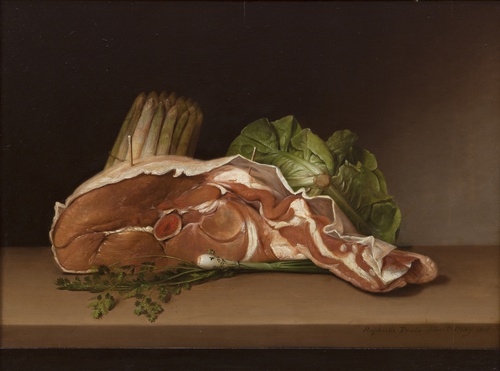
Raphaelle Peale was taught to paint by his father, Charles Willson Peale (1741-1827), an accomplished soldier, scientist, artist, and founder of a dynasty of early American painters. By the age of twenty-one, Raphaelle Peale was recognized as America’s leading still life painter and the first to practice the genre. Peale was greatly interested in delineating the colors and textures of food. The majority of his paintings depict fruit, and such paintings would typically have been used as decoration in dining rooms. Cutlet and Vegetables is one of only two known paintings by the artist of meat and vegetables, and this example is the largest of his known still-life panels, and in exceptionally good condition.
Peale Museum, Philadelphia, by 1817 [1]; M. Thomas & Sons, Auctioneers, Philadelphia (Peale’s Museum Gallery of Oil Paintings, National Portrait and Historical Gallery Illustrative of American History), October 6, 1854, lot 257 (as Cutlet and Vegetables) [2]; Townsend Ward, Philadelphia, 1854; Private collections; Skinner, Inc., Boston, November 11, 1994, lot 69 (as Still Life—Beef and Cabbage); Schwarz Galleries, Philadelphia, 1994; Acquired by the Putnam Foundation, 2000
Provenance Notes:
[1] In what is said to be a manuscript page of additions to the Peale Museum catalogue in Charles Willson Peale’s hand, the work is titled “231. A loin of Veal” (Historical Catalogue of Paintings in the Philadelphia Museum [1813, with later handwritten additions; Historical Society of Philadelphia]). On March 4, 1817, in an advertisement for the Peale Museum in Philadelphia, Poulson’s American Daily Advertiser announced that “numerous valuable and interesting subjects” had been added to the display, including “A Still Life Piece, representing a fillet of Veal and Vegetables.—Painted by Mr. Raphael Peale.”
[2] The picture apparently stayed with the Peale Museum until the auction sale of the collection in 1854, when it was purchased by Townsend Ward, librarian of the Historical Society of Pennsylvania, for $20.00—the highest price given for any of Peale’s still lifes then on offer. In an annotated copy of the 1854 sales catalogue, it is called Loin of Veal (M. Thomas and Sons, Auctioneers, Peale’s Museum Gallery of Oil Paintings, National Portrait and Historical Gallery Illustrative of American History, October 6, 1854, lot 257 [copy in the Historical Society of Philadelphia]).
Philadelphia, Peale Museum, March 1817 and later; Cincinnati, Ohio, Peale Museum Collection, 1852; Washington, D.C., Corcoran Gallery of Art, 1997, The Peal Family: Creation of a Legacy, 1770-1870, not in cat.; Philadelphia, Schwartz Gallery, 1997, 150 Years of Philadelphia Still Life Painting, cat. By Robert Devlin Schwartz, entry by William H. Gerdts, pp. 20-23, ill.
Poulson’s American Daily Advertiser (Philadelphia), March 4, 1817; Alexander Nemerov, The Body of Raphaelle Peale: Still Life and Selfhood, 1812-1824 (Berkeley, 2001), pp. 83-140
The Timken provides collection images to scholars, educators, publishing companies, commercial entities, and the public. Please review the TERMS GOVERNING REPRODUCTIONS OR PUBLICATION OF IMAGES.
To proceed with your image request, fill out the Image Request Form and email it to registrar@timkenmuseum.org.
For questions please contact info@timkenmuseum.org.
This record has been reviewed by Timken Museum of Art staff and may be incomplete or contain errors. Our records are constantly revised. Inquiries about provenance are advised to contact the Director of Curatorial Affairs: curator@timkenmuseum.org.