Artist
John F. Peto
Title
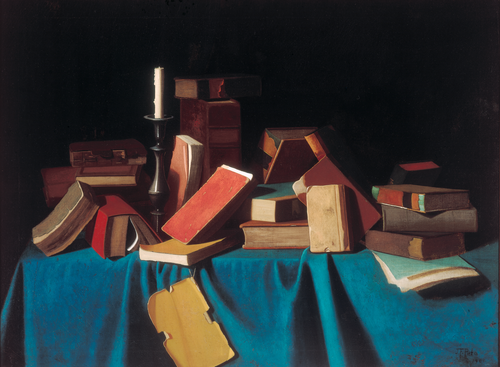
In the Library
Date
1894-1900
Culture
American
Medium
Oil on canvas
Dimensions
76.2 x 101.6 cm (30 x 40 in.)
Accession Number
2000:001
Credit Line
John F. Peto, In the Library, 1894-1900, oil on canvas, 76.2 x 101.6 cm (30 x 40 in.), Putnam Foundation, Timken Museum of Art
Description
The books that make up the painting are in poor shape. They pile and tumble across a sky-blue tablecloth, covers chipped, leather bindings blistered, their spines split through careless use. A sheaf of papers at right projects uncomfortably beyond the table's limit and an especially tattered cover hangs precariously over the front edge, prevented from falling into our space only by the thinnest triangle of thread. The painting's only vertical element is the unlit candle that emerges from the furled lip of a pewter holder. Another source of light from the left illuminates the picture's stripped-down geometry. Peto was one of several masters of trompe l'oeil (trick-the-eye) painting who emerged from Philadelphia toward the end of the 19th century. Decades after the Peale family introduced the genre of still life painting to the region, Peto's hyperrealism competed with the likes of John Haberle, Jefferson David Chalfant, and William Michael Harnett, whose works were so similar that they became confused by later scholars of American art.
RelEvAnt Information / Media
Provenance
Exhibited
Literature
Rights & Reproductions
Note

ADMINISTRATIVE OFFICE
LOCATION & HOURS
Get Directions >SIGN UP FOR OUR NEWSLETTER
Subscribe >


FOLLOW US

.png)