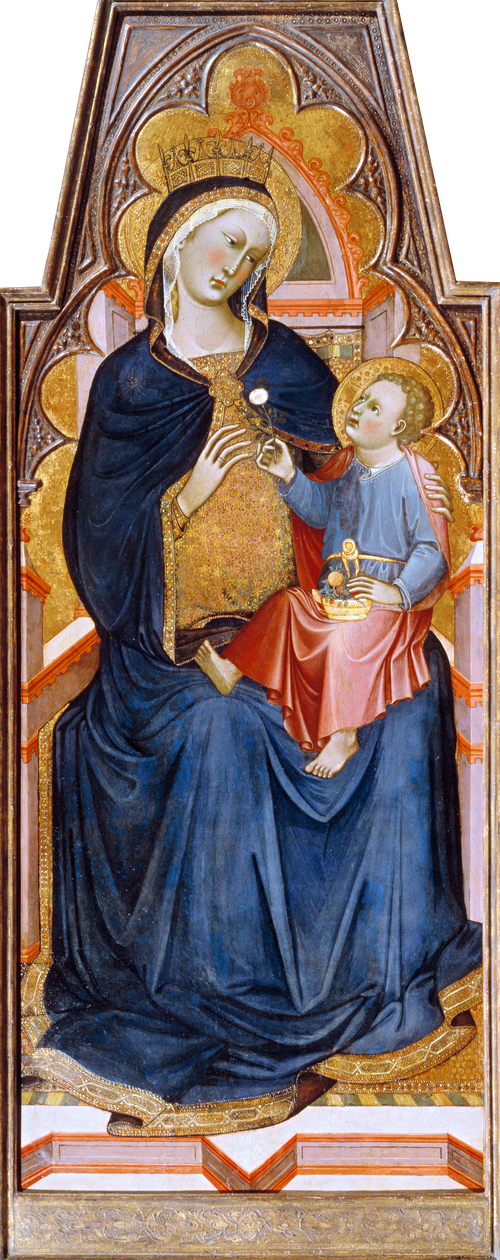
Seated on an elaborately carved Gothic throne, the Madonna inclines her head toward the Christ Child. She raises her hand to reach for a white rose, symbol of purity, that her son offers to her form the small basket on his lap. This painting was the central panel of a now dissasembled signed and dated alterpiece by Niccolò di Buonaccorso, one of the most accomplished masters active in Siena in the second half of the fourteenth century. The size and lavishness of the panel suggests that the whole altarpiece was an expensive commission of some importance and prestige, possibly for the high alter of a church or private chapel.
Santa Margherita a Costalpino, Siena [1]; Galerie Fisher, Lucerne, November 24–28, 1953, lot 1877 (as Bartolo di Fredi) [2]; Heinz Kisters, Kreuzlingen; Acquired by the Putnam Foundation, 1998
Provenance Notes: [1] The importance of this impressive, exceptionally well-preserved work
was first recognized by Miklós Boskovits in 1980 (Miklós Boskovits,“Su Niccolò di Buonaccorso, Benedetto di Bindo, e la pittura senese del primo Quattrocento,” Paragone, nos. 359–61 (1980): 4–5, 15 n. 5), when he identified it as the missing central panel of a signed and dated altarpiece by Niccolò di Buonaccorso, formerly located in the parish church of Santa Margherita a Costalpino, on the outskirts of Siena. The existence of this altarpiece had been first recorded in the early nineteenth century by the Sienese historian Ettore Romagnoli, who wrote
that in 1822 he had discovered in the church of Santa Margherita three panels from a dismembered triptych, showing, respectively, the Madonna and Child, St. Margaret and the Dragon, and an unrecognizable, badly damaged male saint.
[2] The present panel appeared on the art market in 1953, without a signature or date, and a tentative attribution to Niccolò’s older contemporary Bartolo di Fredi. This identification remained unquestioned for thirty years, while the painting remained in the collection of Heinz Kisters, in Kreuzlingen, Switzerland. Boskovits was the first author to point out, aptly, the close stylistic relation of the Madonna and Child to the Costalpino St. Lawrence —restored to its original appearance between 1943 and 1946 and subsequently catalogued as a work of Niccolò
by Bernard Berenson—leaving no grounds for doubt that the two images were executed by the same hand, and that they were originally included in the same complex.
Baltimore, The Walters Art Gallery, :1962, The International Style, cat. by Philippe Verdier and Dorothy Miner, no. 25, pl. XV; Hartford, Wadsworth Atheneum, :1965, An Exhibition of Italian Panels and Manuscripts from the Thirteenth and Fourteenth Centuries in Honor of Richard Offner, p. 28, no. 32.
K. Ames, "An Annunciation by Niccolò di Buonaccorso," Wadsworth Atheneum Bulletin 2, no. 2 (1966): 24; Bernard Berenson, Italian Pictures of the Renaissance: Central Italian and North Italian Schools, 3 vols. (London, 1968), 1:294; H. W. van Os, Marias Demut und Verherrlichung in der sienesische Malerei, 1300-1450 (The Hague, 1969), p. 117, pl. 56; Agnes Mongan and Elizabeth Mongan, European Paintings in the Timken Art Gallery (San Diego, 1969), pp. 24-25, 108, no. 4, ill.; Burton Fredericksen and Federico Zeri, Census of Pre-
Nineteenth Century Italian Paintings in North American Public Collections (Cambridge, Mass., 1972), pp. 149, 291,302, 314, 381, 388, 632; Martin E. Petersen, "Three Centuries of European Paintings,1300-1600," Apollo 115 (June 1982):441, fig. 2;A.-. Dore,"Niccolò di Buonaccorso," in L'Art gothique siennois, exh. cat., Avignon, Musée du Petit Palais (Florence, 1983), pp. 261-62;
Timken Art Gallery: European and American Works of Art in the Putnam Foundation Collection (San Diego, 1983), pp. 68-69, 1:22, no. 25,ill.;Marvin Eisenberg, Lorenzo Monaco (Princeton, 1989), p. 56 n. 56; G. Freuler, Bartolo di Fredi Cini (Disentis, Switzerland, 1994), p.494; Laurence B. Kanter, Italian Paintings in the Museum of Fine Arts, Boston, vol.1., Thirteenth-Fifteenth Century (Boston, 1994), p. 106.
The Timken provides collection images to scholars, educators, publishing companies, commercial entities, and the public. Please review the TERMS GOVERNING REPRODUCTIONS OR PUBLICATION OF IMAGES.
To proceed with your image request, fill out the Image Request Form and email it to registrar@timkenmuseum.org.
For questions please contact info@timkenmuseum.org.
This record has been reviewed by Timken Museum of Art staff and may be incomplete or contain errors. Our records are constantly revised. Inquiries about provenance are advised to contact the Director of Curatorial Affairs: curator@timkenmuseum.org.