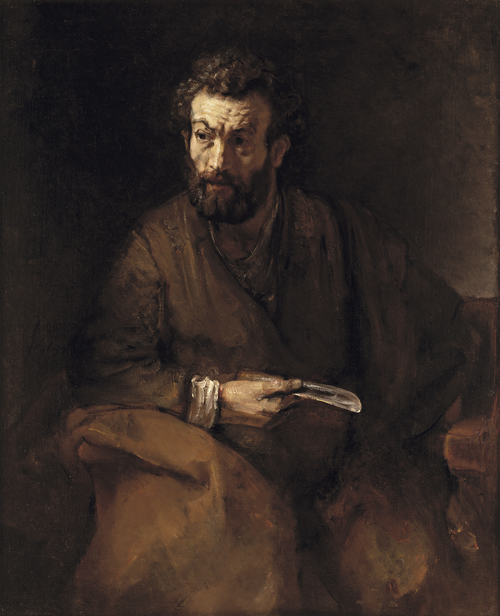
Rembrandt van Rijn is one of the greatest artists of all time and acclaimed for his compelling representations of the human condition. Known primarily for his portraits and landscapes, Rembrandt remained interested throughout his life in history and biblical painting. The subject of this large, dramatic painting from the artist's mature period is Saint Bartholomew, one of the twelve apostles. The apostle, flayed alive for his beliefs, holds in his right hand a butcher's knife, a symbol of his martyrdom. The saint's slightly unsettled pose and expression of deep thought suggest that he is contemplating his own demise. Rembrandt conveys a mood of introspection in his late works-in contrast to his earlier, more theatrical pictures-and renders light, textures, and the sense of form in space with complex schemes of loose brushwork and glazes.
Getty Museum announces online resource to mark Rembrandt Anniversary Year, Rembrandt in Southern California: https://rembrandtinsocal.org/. To see the Press Release Click Here!
Jonathan Richardson, London, sale by Mr. Cock, Covent Garden, London, March 3, 1747, lot 49, to William Fauquier [1]; William Fauquier,(London?) [2]; Dr. Robert Bragge, sale (Prestage), London, February 9, 1757, lot 48, to Sir Joshua Reynolds, London, for 26 guineas [3]; Possibly lent by Sir Joshua Reynolds to “Mr. Humphreys, King Street,” around 1770 [4]; Acquired, possibly at Paris, by Jean Charles François (Ivan Stepanovich) de Laval de la Loubrerie, Count Laval (1761–1846) (St. Petersburg), by 1790(?) [5]; By inheritance to Ekaterina Ivanovna “Katacha,” Countess Laval (1800–1854), 1846–1854; By inheritance to Elisaveta Sergeevna, Princess Trubetskaia (Trubetskoy) (1834–1918), 1854–1912; By gift to Princess Trubetskaia’s grandson, Vassili VassilievichDavydoff (1877–unknown), by 1912; Sold to Thomas Agnew & Sons, London, by V. V. Davydoff, 1912; Possible sale to Henry Goldman by Duveen, New York, 1912 [6]; Collection Henry Goldman (d. 1937), New York, by 1912–37; “Bought from estate of Henry Goldman, deceased,” by Wildenstein, New York, December 22, 1947 [7]; Acquired by the Putnam Foundation, 1952 [8]
Provenance Notes:
[1] The confusion between the Timken “St. Bartholomew” and the Getty Museum “St. Bartholomew” is resolved convincingly by Francis Broun (Sir Joshua Reynolds’ Collection of Paintings [Doctoral dissertation, Princeton University, 1987], pp. 45–47, no. 4). It now appears clear that the painter and collector Jonathan Richardson owned the Timken piece, not the Getty painting.
[2] Though the identity of William Fauquier is uncertain, he may have been William Fauquier, London (1708–1788), who had been admitted to the Royal Society a few weeks before this sale, on January 29, 1747. Fauquier’s brother Francis (1703–1768) was colonial governor of Virginia.
[3] Price per Broun, 1987
[4] Broun, 1987
[5] The primary source regarding the Russian ownership history of the piece, including its sale to Agnew, is Alexander Davydoff (Russian Sketches: Memoirs [Hermitage Press, New Jersey, 1984], pp. 61–65, “St. Bartholomew”). This source corrects a number of inaccuracies, including the identity of the first Franco-Russian owner, the Count Laval (Broun, 1987, incorrectly suggests
Anne-Adrien-Pierre de Montmorency, duc de Laval, b. 1768). The date given by Davydoff for Laval’s acquisition of “St. Bartholomew” (around 1790) corresponds well with the suggestion by Francis Broun (1987) that Reynolds had already disposed of the piece prior to his 1791 sale at Ralph’s, London.
[6] C. Hofstede de Groot (A Catalogue Raisonné of the Works of the Most Eminent Dutch Painters of the Seventeenth Century, 8 vols. [London, 1908–27]: Vol. 6 [1916]:120, no. 169. [Reprinted Teaneck, New Jersey, 1976]) reports that Goldman purchased the painting in 1912 from Duveen in New York; other sources show that it had been purchased from V. V. Davydoff by an agent of Agnew, also in 1912, at Berlin.
[7] From Elliott W. Rowlands, Wildenstein, December 2000. The breakup of Goldman’s collection is also reported in Art News (February, 1948), p. 38 ff.
[8] Every Picture Has a Story: Looking at History through Art (Timken Museum of Art, San Diego), October 2000–February 2001, exhibition brochure, ill. provides additional detail regarding the 19th- and 20th-century provenance of “St. Bartholomew,” including information on sale prices and the condition of the painting. Anne T. Woolett of the J. Paul Getty Museum, who performed research on the painting in preparation for the 2005 Late Religious Portraits exhibition, supports its ownership by the18th-century collectors, Richardson, Fauquier, and Bragge.
New York, The Metropolitan Museum of Art, extended loan, 1913-14; The Detroit Institute of Arts, I925, Catalogue of a Loan Exhibition of Dutch Paintings of the Seventeenth Century, no. 22.; The Detroit Institute of Arts, 1930, Catalogue of a Loan Exhibition of Paintings by Rembrandt, no. 59, ill.; New York, Wildenstein & Co., I950, A Loan Exhibition of Rembrandt at Wildenstein, no. 18, ill; Toronto Art Museum, :195I, Rembrandt Exhibition, no. 10 Washington, D.C., National Gallery of Art, extended loan, 1952-65.
Wilhelm von Bode, "Neuentdeckte und wiedererstandene Gemiilde von Rembrandt," Der Cicerone 4 (July 1912): 505-8, ill.; C. Hofstede de Groot, A Catalogue Raisonné of the Works of the Most Eminent Dutch Painters of the Seventeenth Century, 8 vols.(London, 1908-27): 6:120, no. 1.69; Wilhelm R . V a l e n t i n e r , R e m b r a n d t : Wiedergefundene Gemälde, Klassiker der Kunst (Stuttgart, 1921), p. 82, ill.; id., The Henry Goldman Collection (New York, 1922), no. 14, ill.; Georg Gronau, "Die Sammlung Henry Goldman," Der Kunstwanderer 6 (1924): 345; Frank E. Washburn Freund, "Eine Ausstellung niederländischer Malerei in Detroit,” Der Cicerone 17 (May 1925): 461., 463, ill.;
Werner Weisbach, Rembrandt (Berlin, 1926), pp. 577-78, 626; W. R. Valentiner, "The Henry Goldman Collection," Art News 25 (May 14, 1927): 17, ill.; id., "Important Rembrandts in American Collections," Art News 28 (April 26, 1930): 65, ill.; A. Bredius, The Paintings of Rembrandt (London, 1937), p. 26, no. 613, ill.; "Countrywide Loans from California," Art News 55 (November 1956): 33; Kurt Bauch, Rembrandt Gemälde (Berlin, 1966), p. 12, no. 217, ill.; Sherman E. Lee, "Rembrandt: Old Man Praying," Bulletin of the Cleveland Museum of Art 54 (December 1967): 30. n.7; Horst Gerson, Rembrandt Paintings (Amsterdam,1968), p. 378, no. 296, ill.; Richard Hamann, Rembrandt (Berlin, 1969), p. 460; Paolo Lecaldano, L’opera pittorica completa di Rembrandt (Milan, 1969), pp. 118, 119, no. 357, ill.; Agnes
Mongan and Elizabeth Mongan, European Paintings in the Timken Art Gallery (San Diego, 1969), pp. 66, 67, 122-23, no. 23, ill.; Otto Benesch, Collected Writings, ed. Eva Benesch, 4 vols. (London, 1970-73), 1 (Rembrandt): 192-93, fig. 159; Claude Roger-Marx, Rembrandt
(Paris, 1972), p. 342; J. Bolten and H. Bolten-Rempt, The Hidden Rembrandt (Oxford, 1978), p.198, no. 470, ill.; Christopher Brown, Rembrandt: Every Painting, 2 vols. (New York, 1980), 2:58, no. 315, ill.; Jean-Luc Bordeaux, "Baroque to Neo-Classicism," Apollo 115 (June
1982): 450, fig. 9; Timken Art Gallery: European and American Works of Art in the Putnam Foundation Collection (San Diego, 1983), pp. 70-7I, I22-23, no. 26, ill.; Gary Schwartz, Rembrandt: His Life, His Paintings (Harmondsworth, 1985), p. 310, fig. 352; Peter C. Sutton, A Guide to Dutch Art in America (Washington, D.C., 1986), p. 272, fig. 408; Leonard J. Slatkes, Rembrandt: Catalogo completo dei dipinti
(Florence, 1.992), p. 1-50, no. So; Christian Tiimpel, Rembrandt: All Paintings in Colour (Antwerp, 1993), pp. 341., 40I, no. So, ill.; Walter Liedtke, "Rembrandt and the Rembrandt Style in the Seventeenth Century," in Walter Liedtke, Hubert von Sonnenburg, et al., Rembrandt/Not Rembrandt in the Metropolitan Museum of Art, exh. cat., The Metropolitan Museum of Art (New York, 1995), 2:31, fig. 4.
The Timken provides collection images to scholars, educators, publishing companies, commercial entities, and the public. Please review the TERMS GOVERNING REPRODUCTIONS OR PUBLICATION OF IMAGES.
To proceed with your image request, fill out the Image Request Form and email it to registrar@timkenmuseum.org.
For questions please contact info@timkenmuseum.org.
This record has been reviewed by Timken Museum of Art staff and may be incomplete or contain errors. Our records are constantly revised. Inquiries about provenance are advised to contact the Director of Curatorial Affairs: curator@timkenmuseum.org.