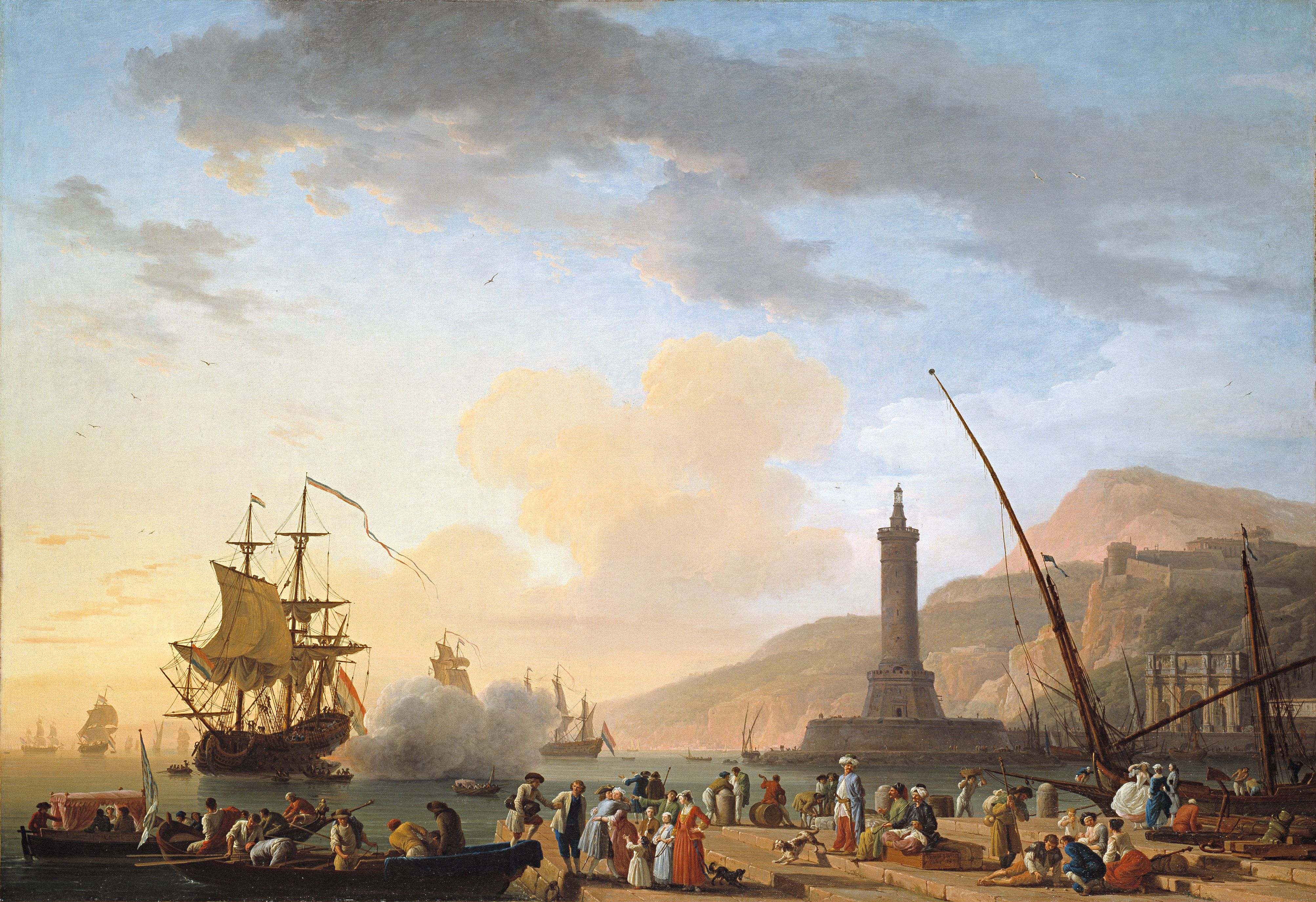
Even at the end of the day, it is a busy port. Shadows are lengthening and dusk begins to settle, but a variety of figures are spread across a broad stone pier. A landing party has evidently just arrived and family members rush to embrace a young man who disembarks from the small dinghy. Visitors in exotic costume converse and take casual note of the reunion while sailors distract themselves by playing games of chance. A couple of dogs snarl at each other on the steps. In the middle of the bay, a Dutch warship has just fired a shot--a friendly salute--and plumes of orange and grey smoke billow from its stern. What does all of this signify? Why did Claude-Joseph Vernet (1714-1789) paint this particular view?
In all likelihood, this is an invented scene. Cecil Gould, writing for the Timken’s 1996 collection catalogue, suggested that the picture depicts the port of Naples. But Gould points out there is scant topographical evidence to clinch this as a portrait of that Southern Italian city. A Seaport at Sunset was completed in Rome in 1749. In fact, Vernet painted numerous views of Naples during his long, successful career. Many of these were done for wealthy grand tourists who craved dramatic proof of their cultured travels. An entry in Vernet’s notebook written around this time records the commission for a pair of seascapes by Charles-Louis Beauchamp, better known today as the Comte de Merle. The Comte was a French diplomat, as well as a connoisseur of painting and sculpture. The sale of his personal collection in Paris on March 1, 1784 was a noteworthy event and was extremely well documented. One catalogue included a long entry, #22, on a pair of works by Vernet:
Two paintings representing different aspects of Naples from its port; one shows the sun setting and the arrival of a sailor who is announced by a cannon shot; a group disembarks from a launch and is welcomed by men, a woman and child. Numerous figures of different nationalities are scattered throughout the foreground, some sitting, some occupied with transporting merchandise. To the composition’s right, a lighthouse stands at the entry to the canal while in the distance we see the prosperous port itself. On the same half of the composition, one notes the tall mountains that surround Vesuvius. A warm sky tops this magnificent picture with its 46 major figures, made as beautifully and as well arranged as could possibly be desired.
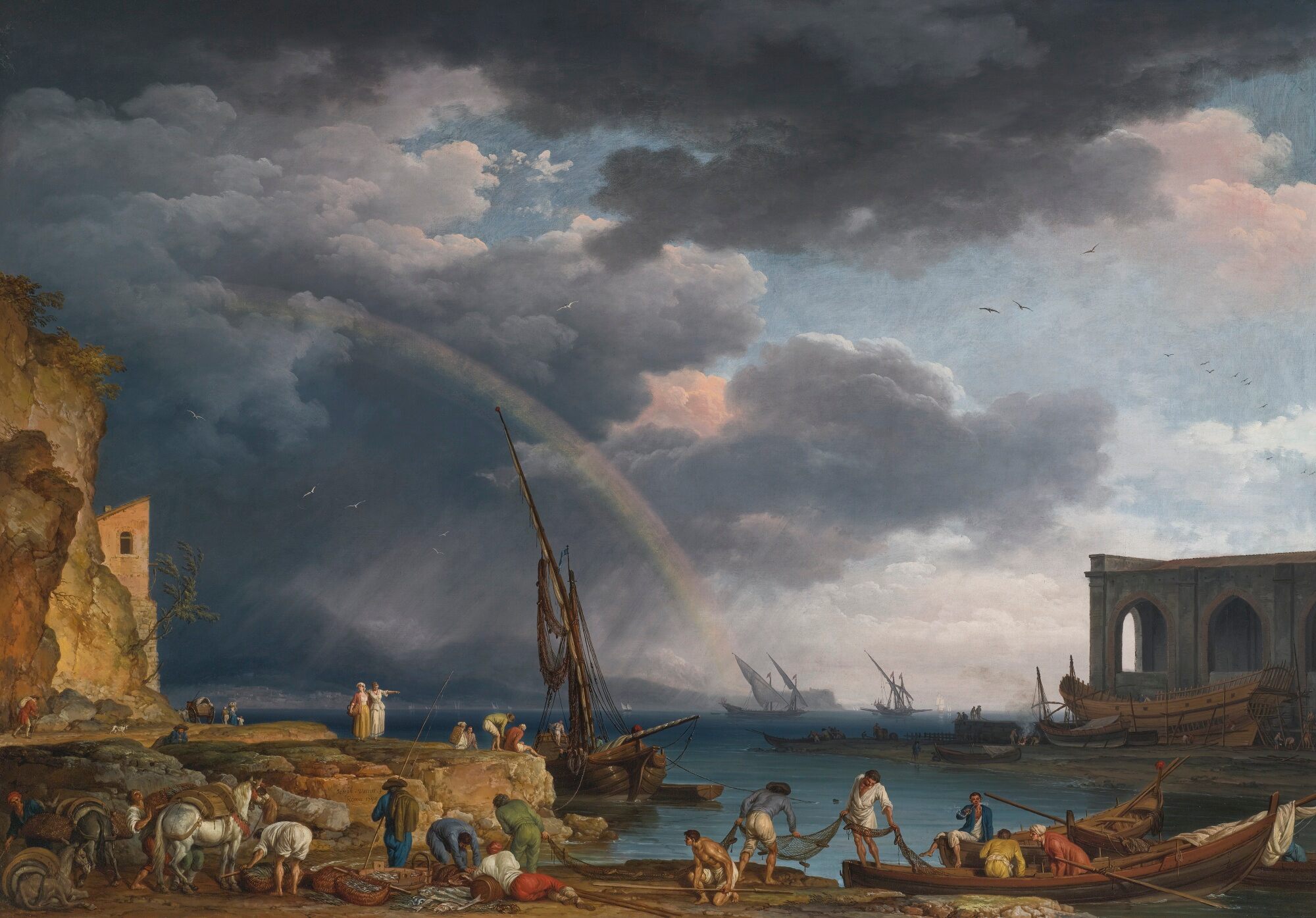
The other painting, also a view of the port of Naples, represents a great body of water. Through the rain, at left, we glimpse a building which appears to be an Admiralty. On the opposite side, on sees a massive rock protruding into the sea itself. Before it, one counts about 20 figures, some busy loading mules and horses with a variety of goods, the others are fishermen preoccupied with their catch. A rainbow, ingeniously placed, floats in an admirably clouded sky. These works were signed in 1739. [Alexandre-Joseph Paillet, Catalogue des Tableaux qui Composent le Cabinet de M. le Comte de Merle, pp. 14-15]
Except for the mis-dating, it seems likely that the Timken’s Vernet is the first of the two works described in this catalogue of Beauchamp’s art. Paillet further observed that the two works had “details drawn so precisely [they] could by their charm of color hold their own next to the finest [by] Claude [Gellée (1604-1682)].” The paintings were sold as a pair in 1784 but they did not remain together. For the better part of two centuries, our canvas by Vernet ended up about a dozen miles outside of Dublin, Ireland, at Luttrellstown Castle, where it was displayed until the 1970s, after which it was purchased by the Putnam Foundation for San Diego. Its partner went through a series of owners in France and ultimately came to be known as L’Arc en ciel: An Italianate Coastal View with a Rainbow, Fishermen and Peasants at an Inlet in the Foreground, a Shipwright’s Yard Beyond. That darker, but identically-sized work re-emerged at auction in New York, not too long ago.





.png)