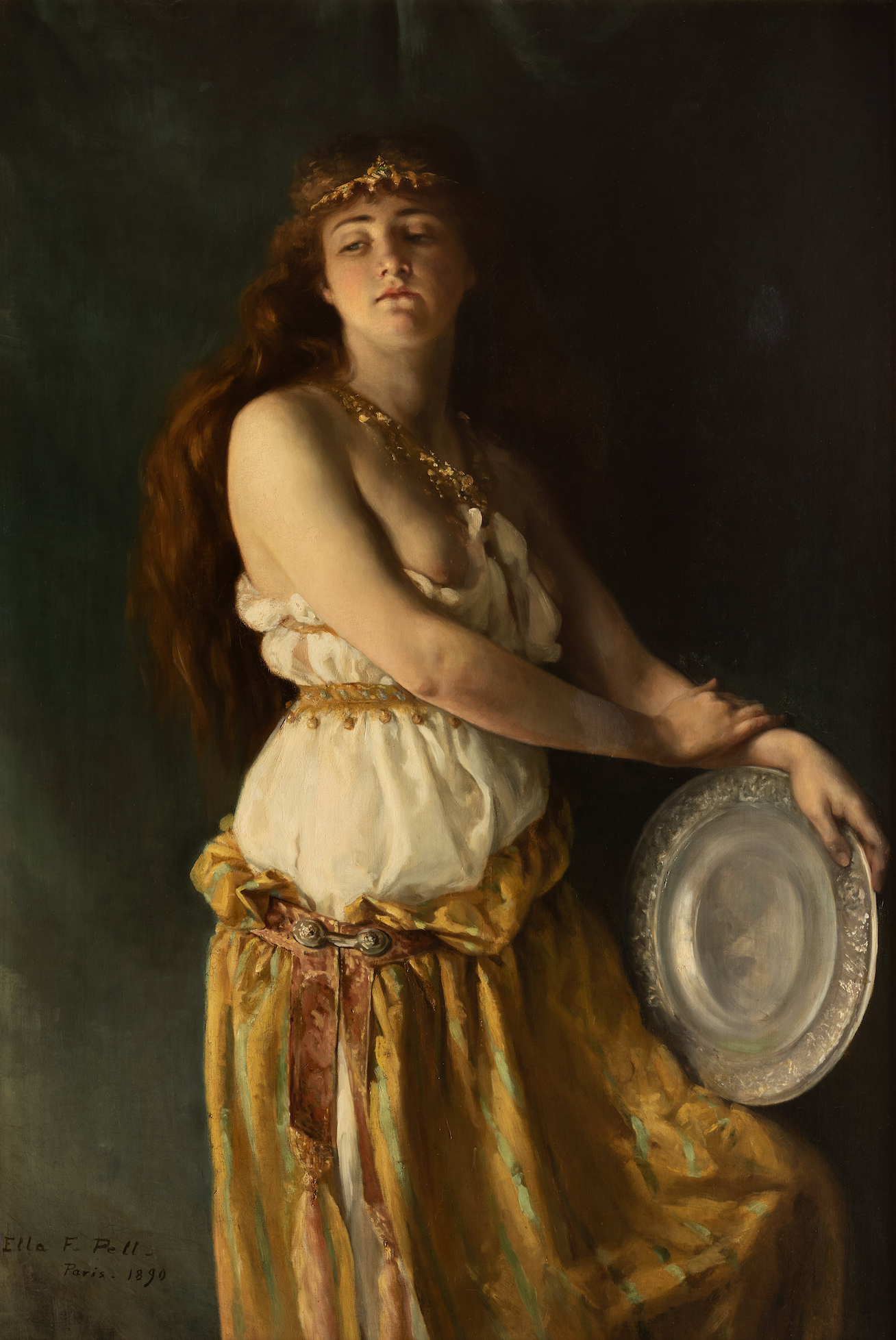
Ella Ferris Pell (1846-1922) rose to a prominent place in American art circles during the decades immediately following the Civil War. First, she studied with the English-born artist, William Rimmer (1816-1879), at Cooper Union School of Design in New York. While still a student, Pell was praised for her sculpture entitled Andromeda that was displayed in a survey of new talent. Accompanied by her sister and brother-in-law, Pell next voyaged throughout Europe and North Africa from September 1872 until November 1878. That trip is documented by a stack of sketchbooks that are today kept at Vassar College. Upon returning to New York, Pell expanded her career as painter and illustrator. Her triumphs in local exhibitions and the leadership roles she played in several New York art groups meant that Pell’s name appeared often in American art journals and newspapers, including the society pages that tracked her summer forays to resorts in the Catskills. At age 43, Pell returned to Europe, determined to get noticed in the thriving expatriate American art community in France. She entered the atelier of Jean-Paul Laurens (1838-1921), among others, where she was steeped in the exotic historicism of late-19th-century academic painting. Pell had success showing numerous works at the Salons of 1889 and 1890, then returned to New York City. Her career continued to bloom for another decade with allegorical subjects being acquired by major museums throughout the United States. In 1905, Pell moved to the small town of Beacon and spent the rest of her life in the Hudson River Valley. There she worked, not quite in obscurity, but without the substantial, visible triumphs that attended her early career.
Salomé was one of two large paintings by Pell displayed at the 1890 Salon. Among the limited number of American works that the jury selected in May of that year, Pell’s depiction of the biblical femme fatale attracted favorable attention. Instead of focusing on the brazen dance of a bejeweled temptress, as Gustave Moreau (1826-1898) had in his Salon entry of 1876 (https://hammer.ucla.edu/collections/armand-hammer-collection), or the adolescent’s legendary blood lust, as so many contemporaries did, Pell represents Salomé as an introspective figure. The embossed, silver platter that will soon receive her reward for pleasing King Herod, the severed head of John the Baptist, rests casually on her striped skirt. Pell gives her anti-heroine an inscrutable expression and an almost ambivalent attitude, attributes that stoked critical debates at the time, and which have earned this painting extensive scholarly attention ever since. Pell herself recognized the stir that this image caused and considered it to be one of her best. After its public exhibition in Paris, Salomé went on display at the National Academy of Design in New York and, subsequently, went on a tour of the United States. It was purchased by the Boston Art Club for its permanent collection in 1896. Pell’s masterwork has been included in numerous exhibitions throughout the world since.
Some of you may recall that Salomé was a centerpiece of the Captivating Women exhibition held at the museum just before the pandemic brought our in-person programs to an abrupt end. Then, as in the past, Pell’s enigmatic picture was a popular favorite with the public.





.png)