Giovanni di Pietro di Bernardone was born in Assisi, Italy, either in late 1181 or early 1182, the records are unclear. Shortly afterwards, the child was renamed Francesco, or Francis. Part of a prosperous family of merchants, Francis’s parents never particularly encouraged their son’s interest in spiritual endeavors. He ultimately renounced his wealth, however, and went into self-seclusion where various encounters helped sharpen his commitment to Christian faith. Soon after, he founded the religious groups that became pillars of the Franciscan Order: the Friars Minor, in 1210, and the Order of Saint Clare, also known as the Poor Clares, in 1212. Just two years after his death, in 1226, Francis was canonized by Pope Gregory IX.
Representations of St. Francis proliferated immediately after his death and included memorable works by Cimabue (c. 1240-1302) and Giotto (c. 1266-1377) whose stark frescoes recounting his life and miracles enliven the walls of the Basilica of St. Francesco in Assisi--if you haven’t seen them, they should be high on your post-pandemic travel to-do list. By the 1400s, Italian artists had largely codified the iconography by which St. Francis became instantly recognizable in numerous prints, sculpture, and easel paintings. One of the greatest of these is by Giovanni Bellini (1431/36-1516) whose shimmering panel, St. Francis in the Desert (1476-78, Frick Collection) is deservedly considered one of the most important examples of Renaissance art to be found in the United States.
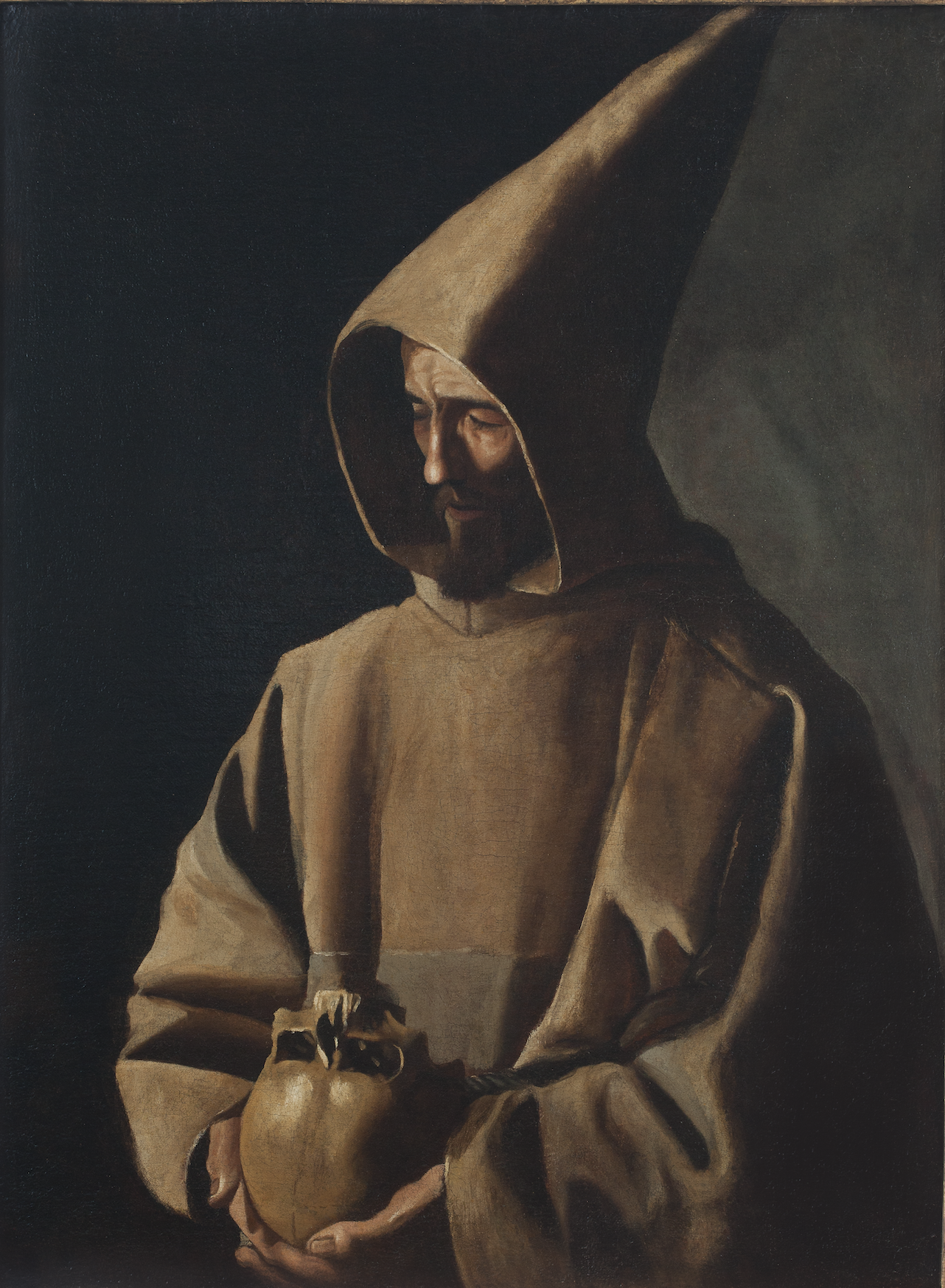
Given this popular context, perhaps we should not be surprised by the fascination that the Spanish Baroque painter Francisco de Zurbarán (1589-1664) demonstrated in his namesake. Zurbarán painted St Francis dozens of times during his lifetime. These works were often made for the Franciscan religious orders who commissioned them as objects of devotion, but some may have also been for private individuals, too. There is an austere consistency with which the Sevillian artist represented the Saint, so fundamentally different from Bellini’s luminous approach of a century-and-a-half earlier. The Spanish artist reveled in the stark simplicity of his subject. Shown alone, deep in prayer or meditation, Francis frequently appears as a presence nearly lost among the shadows. Depicted wearing the dark robes of his order, he either looks up ecstatically toward heaven as he does in a work like St. Francis in Meditation (1635-29, National Gallery of London) or gazing downward with intensity, as he does in St. Francis Contemplating a Skull (c. 1635, St. Louis Art Museum) and in the Timken’s painting by the artist. Especially after 1634, when Zurbarán joined his rival Diego Velázquez (1599-1660) in Madrid, his busy studio churned out copies of these works for an eager market of the faithful.
The most recent acquisition to the Timken’s stellar collection, St. Francis in Meditation was acquired in 2015. There is a similar version of this work at the Santa Barbara Museum of Art, also worth a visit soon.





.png)