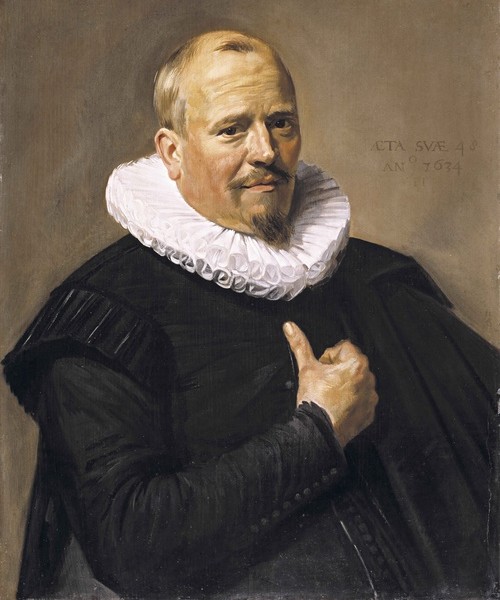
What is there to say about an unidentified portrait?
The Timken Museum of Art has only a couple of these in its permanent collection. It is a curatorial mission, or maybe a folly, to work toward firm identifications of such works. Let’s call the unnamed man in our painting by Frans Hals (c. 1581-1666) Mr. X, just for the time being. In addition to his ingratiating demeanor, we know precious few things about him and his seventeenth-century existence. For instance, we know his precise age at the time he was painted: 48. That number appears prominently on the surface of Mr. X’s portrait, at upper right, above the date and Hals’s own initials. He wears the dark costume that was typical of Dutch community leaders, or regents.
We are pretty sure that he was married, too. His wife had her portrait by Hals painted at the same time. She is displayed--also as an “unnamed” sitter--at the Detroit Institute of Arts. Both of these paintings are on identically-sized oak panels (actually, the measurements provided on the DIA’s website suggest that the Timken support is 1/8 of an inch taller). In contrast to Mr. X’s solicitous look, Mrs. X stares contentedly back at the beholder, hands clasped tightly her lap in proper Dutch fashion. She was 14 years younger than her husband when their likenesses were created. Like him, Mrs. X wears an intricate lace collar of a kind that would make Ruth Bader Ginsburg envious. At some point in their past, the couple split into two different directions. It appears that Mr. X was sent off first to an auction in Amsterdam, in 1873, and Mrs. X ended up in a private collection in Cologne, Germany, until 1912, after which she also entered the art market. We can only wonder why they went separate ways: ungrateful heirs would be one guess.
Since we are speculating, we might further surmise that this couple once lived in Haarlem. Although he was born in Antwerp, Frans Hals worked in that town near the North Sea from roughly 1611 until his death. A picture dated 1634, like this one, would have been created right in the middle of the Thirty Years War, not an especially propitious time. Haarlem was still recovering then from the associated economic turndown of the 1620s. By 1634, having been at it for more than two decades, Hals had nonetheless earned a reputation as Haarlem’s leading portraitist and prosperous clients in the region likely sought him out first. He managed a vibrant studio and even counted Judith Leyster (1609-1660) among his many now-famous students. Leyster went on to become the first female member of the Guild of St. Luke in Haarlem, in 1633, chiefly as a result of her time spent training with Hals. It is possible that Leyster helped with the stream of portrait commissions coming into the studio, but scholars believe that Hals kept the best projects for himself, busying his assistants with the production of genre paintings or copies of his most popular works, for example, his “rough manner” depictions of Dutch types such as Malle Babbe (1633, Gemäldegalerie, Berlin) or The Merry Drinker (1628-30, Rijksmuseum).
Mr. X is not a type. We gaze upon his face from slightly below and recognize that it depicts a real person. Like another memorable portrait by Hals that long ago lost its personal identification, The Laughing Cavalier (1624, Wallace Collection, London), we sense immediately that this was a particular human being, possessing a sense of humility and certain foibles that may remain unknowable to us, but which endeared him to his friends. Hals’s flair for brushwork enhanced this feeling of affability. I imagine Mr. X approaching Hals in his busy studio and striking a bargain with the artist over the paired portraits he thought would help commemorate his life. There is, perhaps, a notarized paper in an archive somewhere that captures this transaction. When it is located, we will learn Mr. X’s name, perhaps his wife’s identity, the date he commissioned the work, and the amount of money he paid Hals to produce these likenesses in oil paint on heavy oak panel. Everything will be just a little clearer. In the meanwhile, we can marvel at the subtlety of the artist’s method, his skills at conjuring personality with a few swiftly applied daubs of paint. As the art historian E. P. Richardson put it, Hals was in demand for his ability to “catch the revealing momentary gesture--the characteristic glance, smile, or gesture of the hand.” In looking at the Timken’s picture, we can’t help but agree that these were the artist’s enduring strengths.





.png)