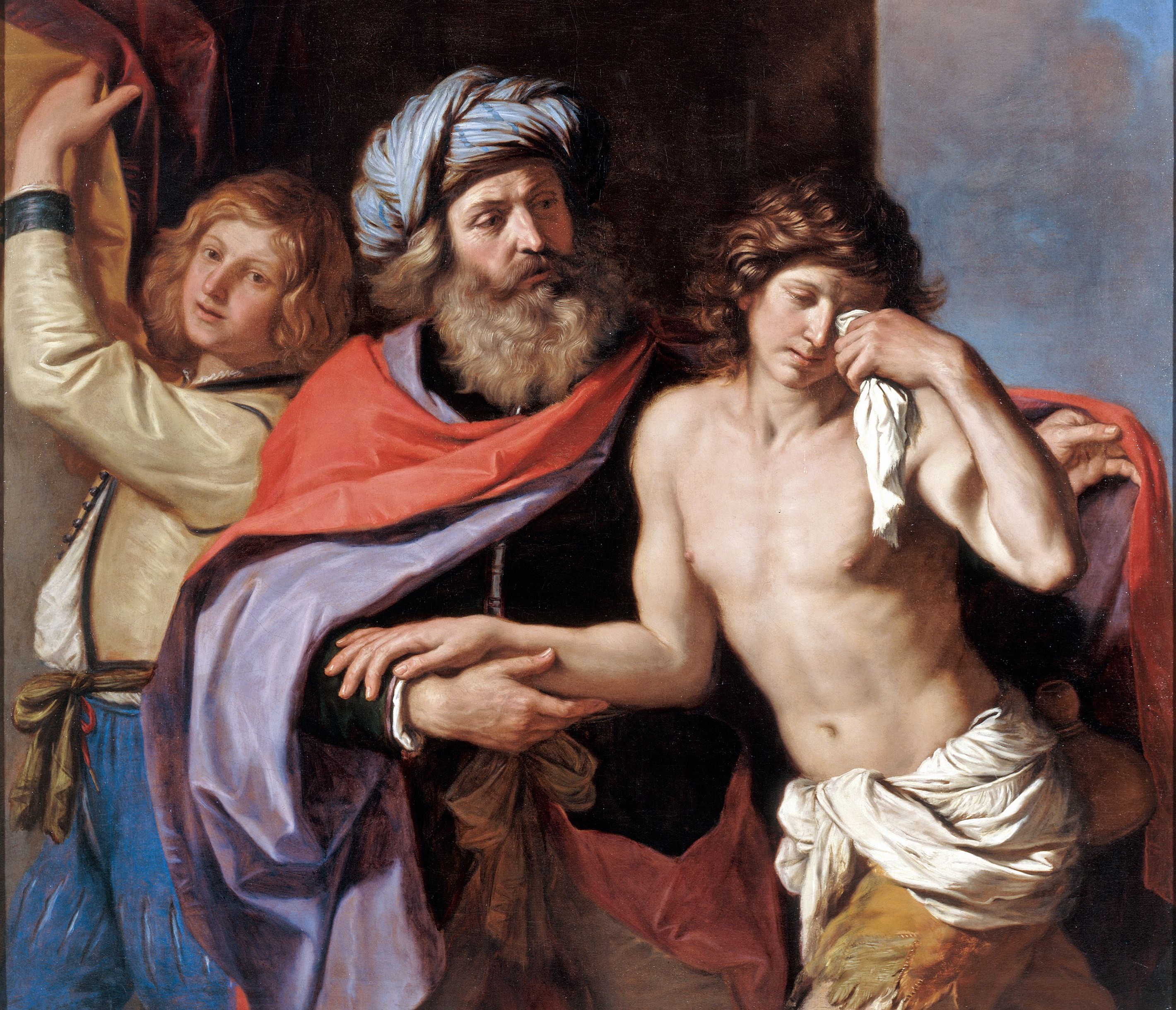
Images of abiding compassion and forgiveness are always welcome. From the Renaissance forward, representations of The Return of the Prodigal Son have addressed that need. The biblical narrative tells the story of a young man who accepts an early inheritance only to squander it. After a long, reckless spree, he returns home full of repentance. His father mercifully takes him in again. Memorable treatments of this iconography are today scattered throughout the great museums of the world: Jacopo Bassano’s hangs at the Prado in Madrid; Rembrandt van Rijn devoted himself to this emotional subject on several occasions but his best-known painted version is at the Hermitage in St. Petersburg; Pompeo Batoni’s can be found at the Kunsthistorisches Museum in Vienna; Bartolomé Estebán Murillo’s has been at the National Gallery in Washington, DC since 1948; Romare Bearden’s modernist collage of this scene is today at the Albright-Knox Gallery. Among the Timken’s masterworks there is an especially moving example of this New Testament parable. Ours is by the great Baroque painter, Guercino (1591-1660).
The Italian artist’s given name was Giovanni Francesco Barbieri, but he was known to all as il Guercino, which translates to “the squinter” in Italian. The cruel nickname is thought to relate to the painter’s condition of having been born cross-eyed. Although he came from a very poor family in Cento (mid-way between the vibrant art centers of Bologna and Ferrara), Guercino’s talents were recognized early on. He went to work for Pope Gregory XV in Rome when he was still in his twenties. In Rome, Guercino had access to advanced art of the past and from there he traveled widely. During this time, his style shifted from its early taste for severe chiaroscuro to a softer, more voluptuous style. After success painting religious works at the Vatican for about a decade, he returned first to his home in Cento and, then, to Bologna, where he became a primary artist in that Northern city.
Guercino worked on the Timken’s version of The Return of the Prodigal Son while in Bologna.
According to the London-based gallerist, Patrick Matthiesen, who sold the Timken its painting, in 1983, ours is the last of seven different versions of The Return of the Prodigal Son that Guercino painted between about 1617 and 1655. The nearly square composition represents the magnanimous father clasping his son by the forearm and extending his cloak over the younger man’s shoulders in what we foresee will soon become an embrace. The son--proverbially “lost and now found again”--wipes away the tears that stream down his face. It is an expression that mixes shame with relief. In the background, another figure pulls back a drape to admit the family back into their private realm. As spectators, we witness simultaneously the sinner’s regret and the humility with which he is received.
San Diego’s version of The Return of the Prodigal Son bears a striking resemblance to another version of this parable by Guercino, one which dates from a similarly late moment in the artist’s career. Both versions were made in early 1650s, but the version painted in 1651 is slightly smaller than the Timken’s and was originally commissioned by a Venetian nobleman. Today, that work belongs to Poland’s Diocesan Museum in Wloclawek (http://muzeum.diecezja.wloclawek.pl/plan-muzeum/barok/). In that scene, Guercino depicts the same bearded father in virtually the same costume, but the prodigal son is represented in pure profile and collapses directly into his father’s chest. Our version was painted about three years later for the Archbishop of Bologna. It shows this same youth frontally, as if addressing viewers first and foremost. He hesitates before receiving his family’s private welcome. It is a noteworthy compositional shift and one that enables Guercino to make a dramatic point: all of this--great contrition followed by extraordinary forgiveness--is intended to educate us.





.png)