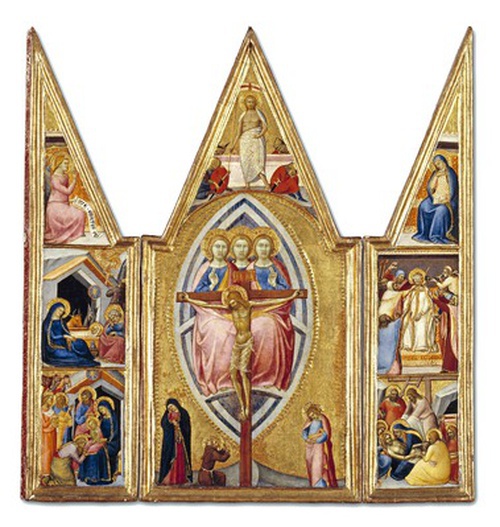
Luca di Tommè (active 1355-1389) was a prolific artist who was among the first to join the painters’ guild in Siena shortly after it formed in 1356. Although it is not certain, scholars have suggested that he likely received his own training from Pietro (act. 1306-ca. 1348) and Ambrogio Lorenzetti (1285-ca. 1348), the important family of artists who dominated Sienese painting during the early trecento (1300s). Luca supervised multiple decorations in the Duomo di Siena, a cathedral begun in the 12th century but which was only completed in his lifetime, around 1348. When not managing the crew of apprentices who populated his thriving workshop, he busied himself with commissions to paint book covers and devotional images--both public and private. These were coveted objects throughout the second half of the 14th century.
The Timken’s small triptych was almost certainly created for a private individual’s use. It is noteworthy for the sheer profusion of its biblical narratives. The whole measures roughly 22 inches wide by 22 inches high, when fully opened, but includes no less than seven detailed scenes from the life and death of Christ on its three hinged elements. The central, largest panel represents the Crucifixion. The body of Christ is framed within a blue and white mandorla (almond-shaped orb) where he is supported by the Trinity draped in an encompassing red shroud. Mourning figures, including Mary, Saints John and Francis, appear at the base of the cross while in the top part of this peaked panel, Luca depicts the Resurrection. The triptych’s wings are similarly sub-divided into corresponding iconographies: at top right and left we have the Annunciation; in the center, the Nativity and mocking of Christ; at bottom, the Adoration and the Lamentation. The whole of this heraldic, dialogic, compressed narrative is set off by its bright gold background, at once paying homage to its Byzantine precedents and asserting its conspicuous presence as a luxury object.
A large number of Luca di Tommè’s works exist today. A few ambitious decorations from the late 1360s through 1370 remain in situ, such as the Altar of St. Anne in Siena (c. 1367) or another altarpiece made for the cathedral of Rieti, south of Perugia, which is signed and dated (1370). A spectacular, painted crucifix of roughly the same date that would have been used in liturgical services is now at the Harvard Art Museums (https://harvardartmuseums.org/collections/object/227905?position=0). More commonly, however, we encounter small panels that have been disassembled from much more complex works, likely to make them saleable to collectors long after the Renaissance. For example, a similarly-sized triptych depicting the Virgin and Child with Sts. Louis and Michael (bef. 1362) can today be found at the Los Angeles County Museum of Art (https://collections.lacma.org/node/232449). A few larger representations, presumably elements of more ambitious altarpieces, are also attributed to the artist. These include The Assumption of the Virgin (1362) at Yale (https://artgallery.yale.edu/collections/objects/263) and St. John the Baptist (late 14th c.), at the Getty (https://www.getty.edu/art/collection/objects/614/luca-di-tomme-saint-john-the-baptist-italian-late-14th-century/). The Timken’s early, complete, and remarkably well-preserved work by Luca is a rare thing, therefore.





.png)