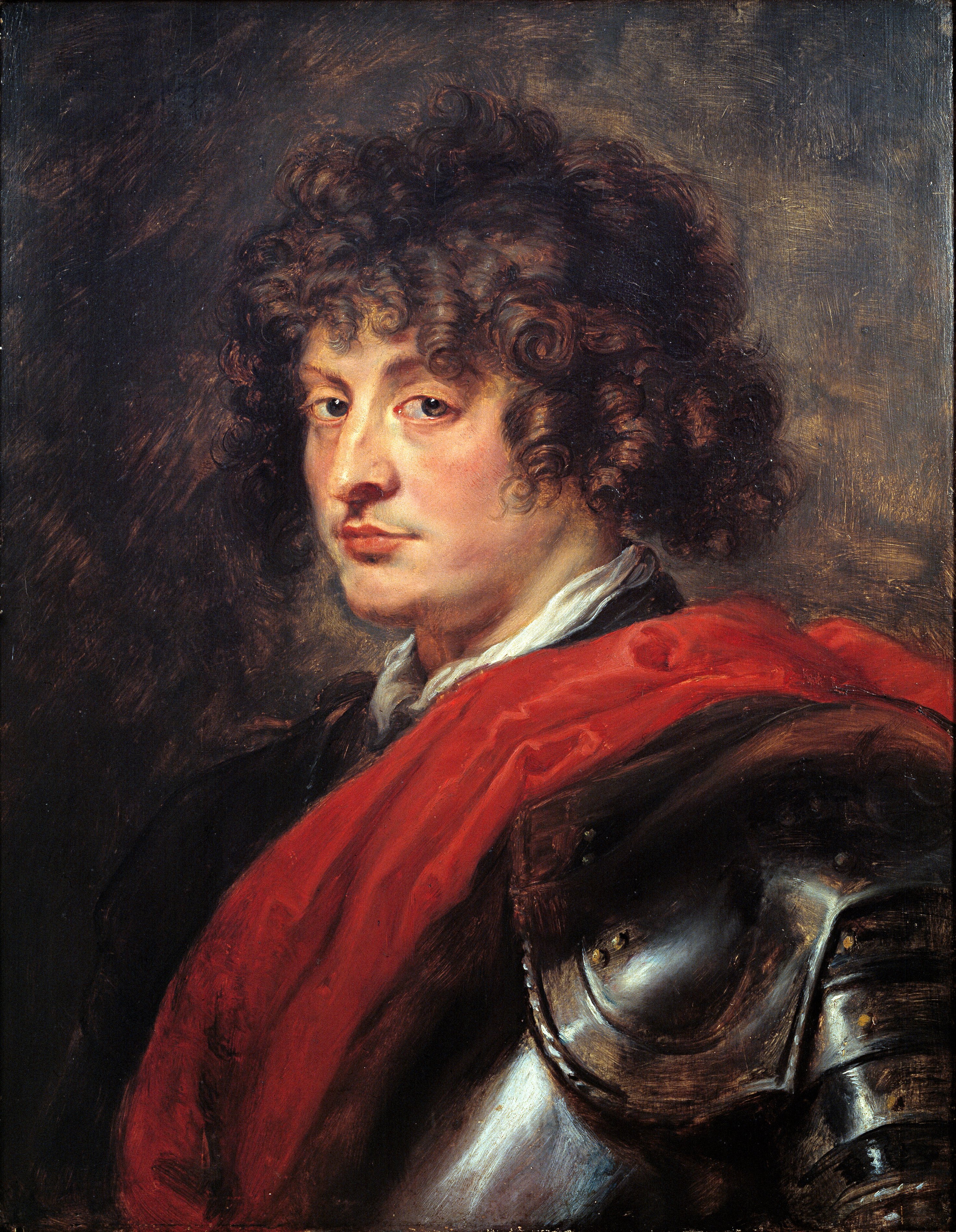
The Timken Museum is full of memorable faces. In the first two dozen of these weekly, brief descriptions of our permanent collection, we’ve encountered many of these portraits already. Some may even recall that I started this series by speculating on the source of Mrs. Gage’s inscrutable expression in the great picture that John Singleton Copley painted hastily at the onset of the American Revolution. Perhaps my favorite likeness of all hangs in the Dutch/Flemish gallery. It is the one by the legendary artist Peter Paul Rubens (1577-1640).
There was a time when scholars felt sure that this was a youthful depiction of Francesco IV, the future Duke of Mantua. When the Putnam sisters acquired the picture, in 1952, they certainly believed Francesco to be the sitter. There is documentary evidence that Rubens painted the eldest son of Vincenzo and Eleanora de’ Medici. We also know that such a painting was displayed as part of the collection of Charles I, who was the artist’s great patron starting in 1629. This is not that painting, however. An article published in Burlington Magazine in 1961, by Michael Jaffé, argued convincingly that the Duke’s likeness by Rubens still hangs in Saltram House, near Plymouth, in Devon, England. The picture the Putnams acquired was instead likely the one described in Rubens’s household inventory at the time of his death as number 129, “a man in armour with a red scarfe”.
So what if this is not a portrait of a Duke? It remains a marvelous example of what Rubens did best: paint a compelling look with a casual flourish, all the while capturing distinct senses of personality and materiality. Scholars since Jaffé have suggested that the image is best understood as a tronie--the Dutch term for “face”—a sample image that portraitists used to show off their creative skills to potential clients. Rubens scarcely needed to advertise his skills. By the 1620s, he was already established as a preferred painter of church altarpieces and commissions for tapestries flooded his busy Antwerp studio. Wealthy collectors clamored to have Rubens paint their family members, and not just in Flanders. He painted the Duke of Bavaria and Anne of Austria around the same time he took time to paint this handsome face. If any further proof of the image’s appeal is needed, at least two later copies exist: a pencil drawing based on the picture was formerly in a renowned British collection and another is today at the Indianapolis Museum of Art. Just over a year ago, a similarly sized work by Rubens, on oak panel, appeared showing a young man with the same rumpled curls and what looks like it might be the same suit of armor. The face looked quite a bit younger and had a less obviously self-assured appearance than the Timken picture. It sold at a London auction house for a little over £3 million.
Let’s be happy that the Putnam sisters had such great taste and, even if they were misinformed about the identity of this particular sitter, they knew--as the painter surely did--when an image had swagger to spare. Because of them, Rubens is well represented in San Diego and we get to study his talents in the strongest possible context at the Timken.





.png)