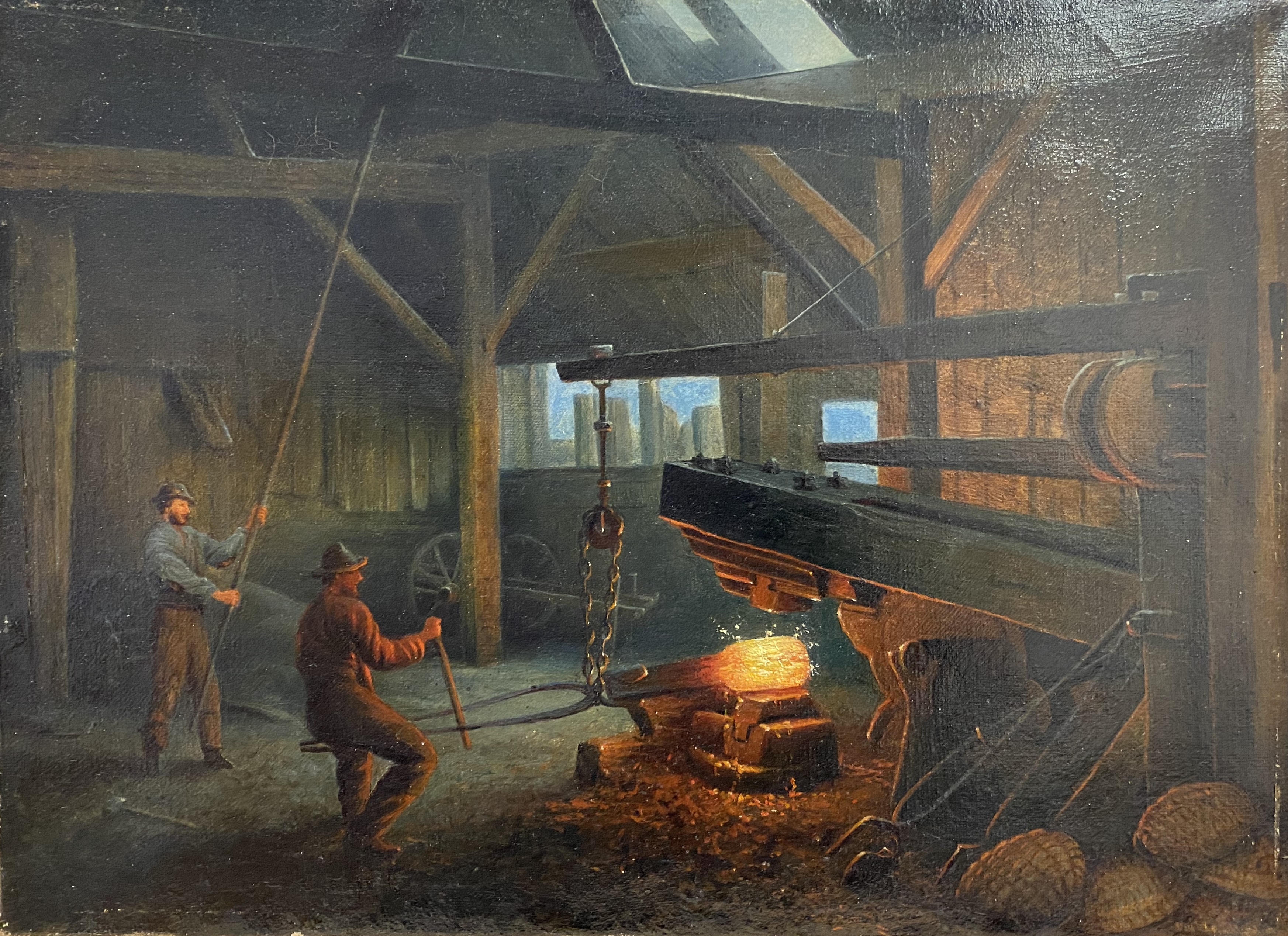
A small painting--from memory, I’d say it measures only about 8 inches tall by 11 inches wide--hangs on a rack toward the back of a secured storage space at the Timken Museum of Art. Without a frame, it appears inconspicuous, even ignoble. It lacks a signature and, if we turn it over, there are no inscriptions or tags on the back of the canvas to help identify it. The wooden stretcher is crudely joined. The members that form the support were planed by hand and bear only a stencil, also applied crudely, in black paint: “10 8 15”. Apart from this, it is a strangely mute thing. The mysterious object refuses to communicate how it even came to be at the museum.
Let’s turn it over and look at it again from the front. I have studied a lot of pictures, and because my own field is North American art, I am confident that this was painted by an American artist sometime during the second half of the 19th century. The dress of the two men it depicts and the type of large iron forge they manipulate suggests this much. The subject matter is familiar, too. During this period, John Ferguson Wier (1841-1926) painted still more heroic versions of laborers working on forges--one is at the Metropolitan Museum of Art and another slightly earlier depiction belongs to the Putnam History Museum in Cold Spring, New York.
The latter reference to Putnam County ought to trigger some recognition for those who know the Timken. The Putnam sisters--Anne, Amy, and Irene--lived in Bennington, Vermont before they moved to San Diego in the early 20th century. Their family’s wealth came from several sources--manufacturing of various kinds, including iron tacks and barbed wire--and meant that they were among both the wealthiest and most philanthropic members of their community. Before the family lived in Vermont, however, they lived in the Adirondacks and ran “the New Russia Forge. . . one of the oldest ironworks in the County, having been erected about the year 1802.” By 1869, the forge was being managed by “Messrs E[lbert] H. and H[enry] A. Putnam,” uncle and father of the Putnam sisters, respectively. The New Russia Forge then “contained four fires and a wooden hammer of about one thousand eight hundred pounds weight” (see Winslow C. Watson, Military and Civil History of the County of Essex, New York, 1869, p. 459).
I think we are looking at that 1800-pound hammer in this small painting. I also think this is the picture that a Putnam relative mentions in a letter sent to Amy and Anne received toward the end of their lives, inquiring whether they still owned the image of the Putnam Forge. It seems possible that they kept it with them in their travels from Vermont to San Diego as a remembrance of their roots in the East. If I am correct, that is how the painting came to be in the vaults of the Timken. Somewhere along the way, it lost its frame along with all the traces of its commemorative function. While I am not necessarily eager to make claims for its aesthetic significance, it is important to the history of the founding of our museum. For that reason alone, I can’t wait to reframe it and share it with you when we all can return to Balboa Park.






.png)